Category Archives: Uncategorized

Creating a Video Game Wedding Invite with Adafruit EdgeBadge and PyBadge LC

Twenty years ago, my spouse-to-be and I met and became friends. During the pandemic, we got engaged and wanted to create a unique and memorable wedding invitation for our friends and family.

Due to a chip shortage, we used both Adafruit EdgeBadge and PyBadge LC to create interactive invitations. These credit card-sized boards are perfect for this purpose, boasting a range of impressive features. Each board includes a 1.8″ 160×128 color TFT display connected to its own SPI port, eight game/control buttons with nice silicone button tops, a triple-axis accelerometer for motion sensing, and a light sensor that points out the front. They also have a built-in buzzer mini-speaker, a mono Class-D speaker driver, a LiPoly battery port with built-in recharging capability, a USB port for battery charging, programming, and debugging, and two female header strips for potential expansions. Additionally, the EdgeBadge supports TensorFlow Lite for Microcontrollers, enabling machine learning features such as voice commands and gesture controls.
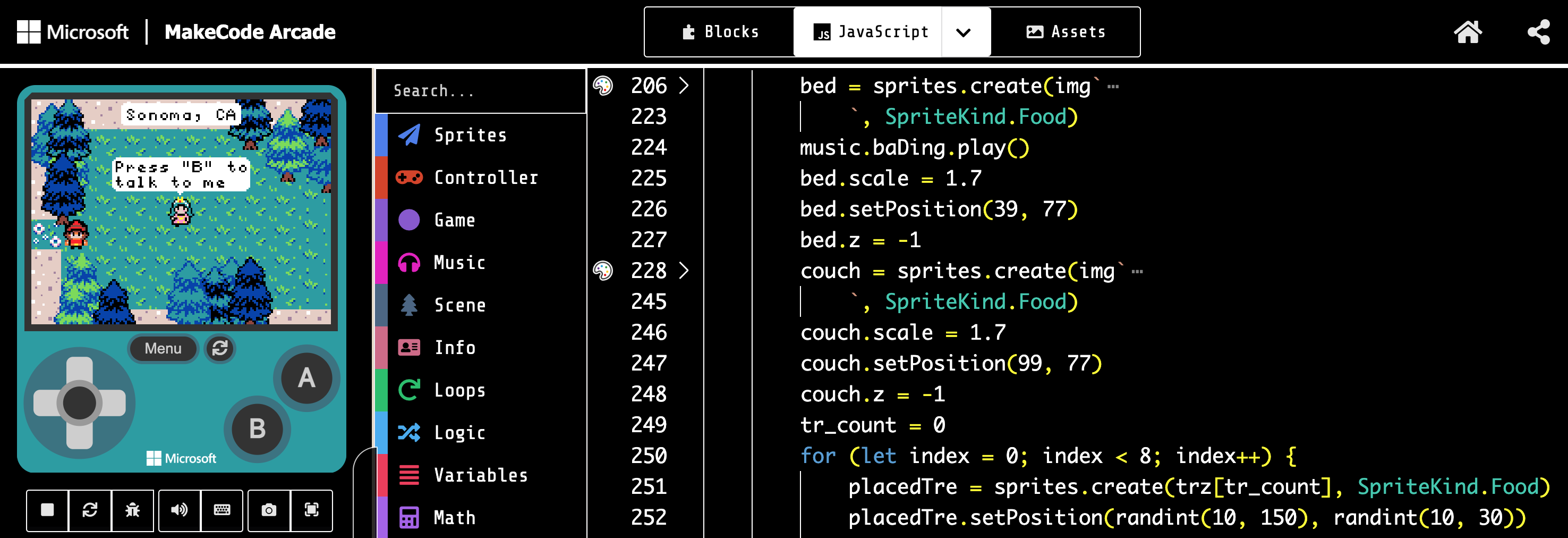
The game was developed using Microsoft MakeCode Arcade with JavaScript. Unique sprites were created using online sprite generators and tweaked for enhancement. Generic assets like trees were sourced from MakeCode Arcade. We also commissioned The Time Cowboy – Jake Lawrence, an Australian Cartoonist / Storyboard Artist, to create the box art and website art, some of which we turned into sprites for a cohesive design.
Designing a game for these low-cost, low-power devices presented its own set of challenges. Despite their capabilities, the first version of the game I created ran great on my MacBook, but the FPS was absolutely atrocious on the devboard! Initially, I thought about recreating the entire venue in the game to allow for an open-world experience, but it was too much for the board to handle.

I had to do some research and bust out some old video game tricks, like efficiently utilizing the same assets and dividing the map into many seamless “levels” that would be triggered and quickly loaded. This was both fun and challenging for someone who typically does bioinformatics work.

for (let index = 0; index < 8; index++) {
    placedTre = sprites.create(
        trz[tr_count], 
        SpriteKind.Food
    )
    placedTre.setPosition(
        randint(40, 160), 
        randint(5, 30)
    )
    tr_count += 1
    if (tr_count >= 4) {
        tr_count = 0
    }
}

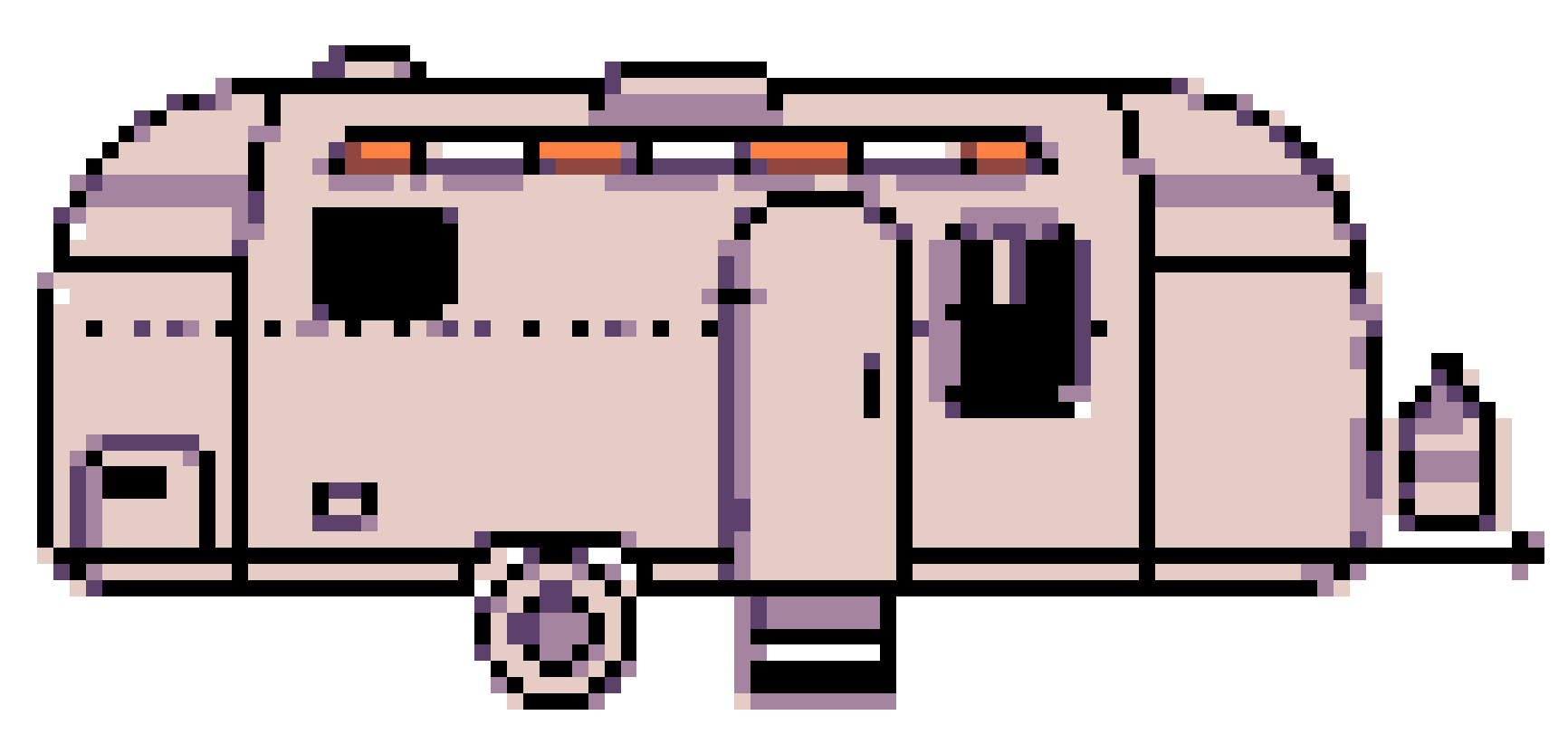
Because I’m of North Indian Mughal descent, our wedding involved multiple days with different rituals, such as an entire messy day where we get covered in turmeric, and another day dedicated to having intricate patterns painted on us with henna. We thought a campground about 60 miles north of San Francisco would be perfect for these multiple days of celebration. This campground had many Airstreams, which we thought would be a comfortable way for our friends and family to spend the time, even if they weren’t familiar with camping.

The music for the game was also a fun project. For the end of the game, I created a MIDI cover of a Depeche Mode track:

“Come with me into the trees,
We’ll lay on the grass and let the hours pass
Take my hand, come back to the land
Let’s get away, just for one day.”


All of this was actually inspired by DEFCON badges, and you can check out the finished game online at MakeCode Arcade, minus the hardware, in your browser. I highly recommend using these kinds of low-cost devboards as gifts to friends and family. They can create their own projects using them, which is also fun to see what people end up making.
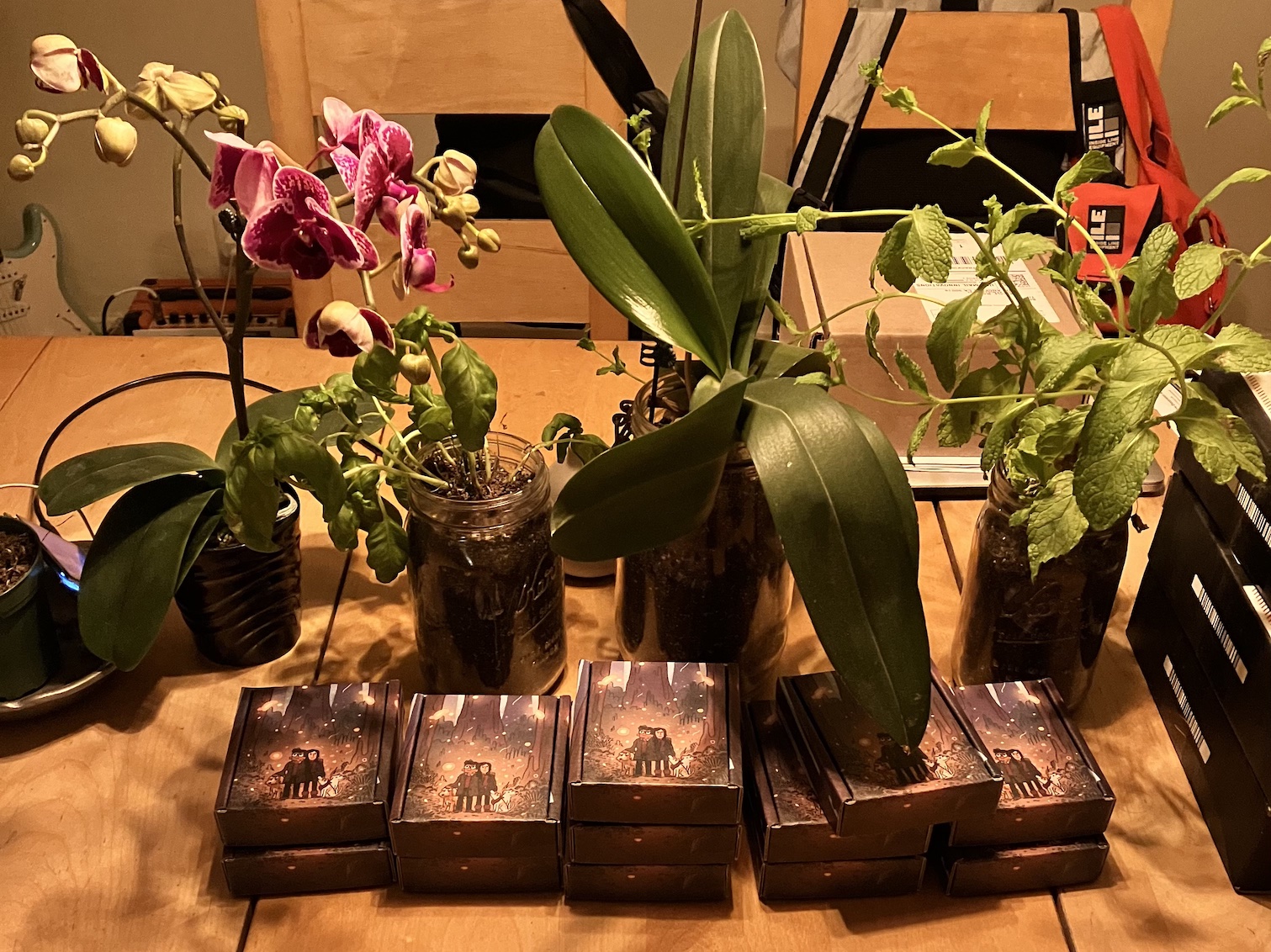
Batches of invites ready to send.

Combining retro gaming charm with cutting-edge tech and cohesive design elements makes for an unforgettable and fun invitation. Try it out and make your invite the talk of the town!
4 Comments

Filed under Uncategorized

E-ink Dev board to track Fetal Development

loading bebe

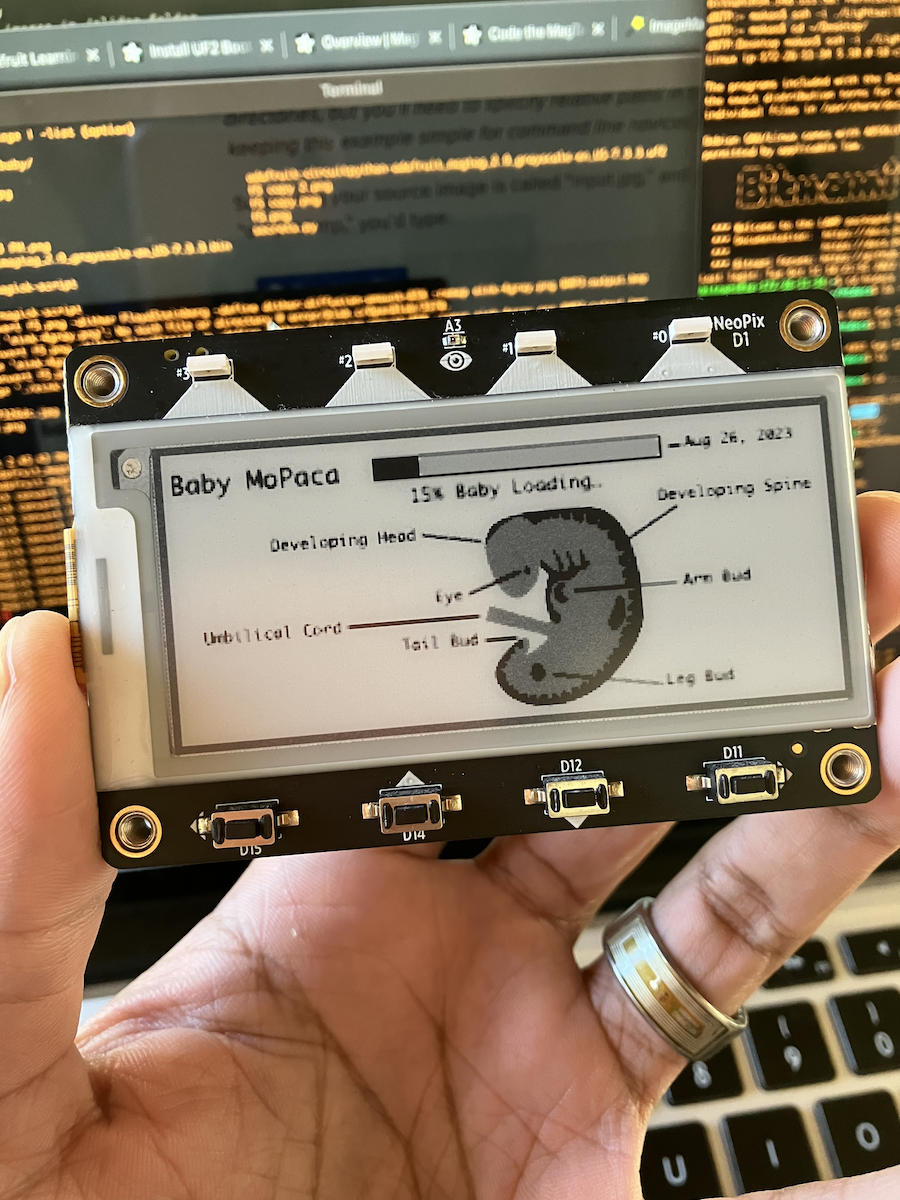
Partner is pregnant, ultrasound looked cool. Had an e-ink dev board collecting dust. So here we are. Pretty simple stuff, the board is an Adafruit MagTag. And all we needed to do was have a progress bar, some graphics, and some text. There are some useful guides to making a progress bar and graphics for this e-ink board HERE and HERE.

I used some wikimedia fetal development graphics for each step. The key thing is to format the image correctly for the e-ink display. This is the ImageMagick command I used to do that:

magick convert input.png -dither FloydSteinberg -define dither:diffusion-amount=0% -remap ./eink-4gray.png BMP3:output.bmp

Have it sticking on the fridge right now, the battery consumption is really low, and only used when updating the progress, should be good for a year or more.


20 Comments

Filed under Uncategorized

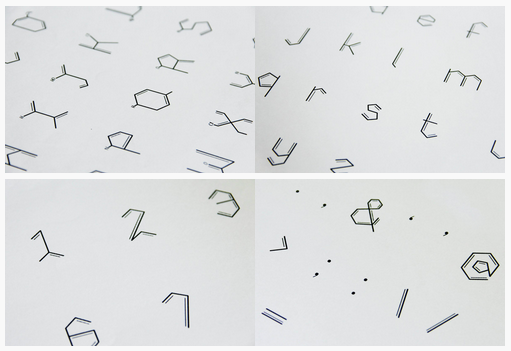
K-Mistry Typeface By Ranmalee Jayaratne

I wanted to take a moment to thank Ranmalee for her wonderful concept and execution of the K-mistry type face in the banner for this site. 

It is refreshing to see young designers take on the difficult challenge of presenting the life sciences and other technical  sectors as appealing. Although it does not come as a surprise that Ranmalee, a 21 year old from Sri Lanka who decided to switch her studies from advanced mathematics to design, found such a wonderful way to balance her output.

If you’re like me, and look forward to what Ms. Jayaratne will create next, be sure to keep an eye on her Behance page.

Leave a comment

Filed under Uncategorized

Industry & Academia, part 1

The biotech, pharmaceutical and life sciences industry poses an interesting conundrum. How do we industrialize a profession of problem solving? From experience, I can say some have done it well, while others have treated the life sciences like a traditional industry. Much of the novel molecules which lead to profitable drugs often have their beginnings in academic research. Here a molecule or procedure showing promise is quickly gobbled up by an industrial giant, with very fair compensations of course. In academic research labs problem solving can bee seen to take a two-pronged approach. The first is collecting and presenting data which will ensure future and continued monetary funding. The second and more important aspect, is everyone in the lab understanding their individual projects from the bottom-up; to understand the basic concepts of nature which are guiding the protocols of an experiment. And it is at this where industry shows it’s largest short-coming. Departmentalizing work within a single project causes individuals to differ responsibility of the overall project success. This creates a lack of vigilance, people let flaws in experimental design slip by, those whose experience can best help troubleshoot aren’t even asked. The biotech industry isn’t young and fledgling anymore and allowing it to be run through the lens of a traditional business will do little to assure future success.

Leave a comment

Filed under Uncategorized

A Breakdown of a Groundbreaking Article

Finding treatments for Parkinson’s disease helps more than just those afflicted with the illness. The mere act of studying the disorder and looking for a cure has increased mans understanding of the physiological structure of the brain and it’s relation to movement of the body.

This article by Kim et al, was published in Nature, vol 418. These researchers are interested in deriving dopamine neurons from embryonic stem cells (ES cells);   Parkinson’s disease is caused by the loss of neurons that produce dopamine.

Showing ES cells with Nurr1 has positive results for multiple markers of dopamine production

To quantitatively measure how much dopamine these ES cells could produce the researchers stained for tyrosine hydroxylase (TH), which  catalyzes the conversion of L-tyrosine to dihydroxyphenylalanine (DOPA), the precursor for dopamine. Nuclear receptor related-1 (Nurr1) is a transcription factor that has a role in the differentiation of midbrain precursors into dopamine neurons.

In the study ES cell lines expressing Nurr1 are compared to native dopaminergic neurons and WT ES cells. Nurr1 ES cells outperform both comparative cell lines in TH stains, showing greater dopamine production.

Once the authors have demonstrated that their ES cell line with Nurr1 can produce dopamine just as well native dopamine producing neurons, they move on to graft the newly created cell lines to show that they don’t lose their capabilities within an animal model. At the very base, this study demonstrates the ability of embryonic stem cells to be turned into neurons capable of producing specific compounds, just as well native neurons.

Leave a comment

Filed under Neurophysiology, Neuroscience, Uncategorized

Some thoughts on the mind

What do we currently know about the cellular structure of the brain? How does it affect our concept of reality? A quick & basic summary:

3 views of the neuron

The cells of the brain, neurons, have a structure very different from the rest of the body.

At the center of the neuron is the soma, the core. From here branch-like structures called dendrites emerge. The axon, is a single stem which can extend from the soma to very distant spaces, ranging from inches to several feet.

Every thought, feeling, perception, or memory causes an electrical potential to be generated at the soma, passed down the axon and then transferred to other neur ons through dendrites. There are millions of connections between neurons, turning the whole brain into one large network.

This is the stage on which our reality unfolds, everything we learn, everything we feel, all movements and all thoughts occurs through the medium of our neural network.

Leave a comment

Filed under Neurophysiology, Neuroscience, Uncategorized