
 Managing Director at Excel Medical Ventures and CEO of Biotechonomy. Begins with talk of economy, dangers of bank leverage. BofA lends out $47 per $1 in-hand. Banks fail, gov tries to help, banks bring gov down as well. Dancing in the flames, this is our [researchers] arena, technology is a larger wave than any financial crisis, you will either be washed away or surf it. Moving from digital code to life code. Man vs mouse 5% difference. Humans transmit code through time. Tribe vs empire as result of standardized code. Changes in code matter, the dominant code is changing, from “01” to “ATGC”. Life is imperfectly transmitted code, imperfection is important. Life code will be the big driver of the global economy. Aileron, protein stabilizers, $1.1B deal. You can order bioreactor and organ printers from Harvard Regenerative Medicine magazine. Community matters, if you’re around happy people you are happy, if you are around obesity than you are inclined to be obese, importance of startup culture to medicine. Can’t genomics be dangerous? Prove to me it will never hurt anyone and we’ll allow you to sell it, in this scheme table salt would not pass FDA clinical trial. Must innovate information infrastructure to handle genomic data.
Live @ Future of Genomic Medicine IV: Juan Enriquez – Understanding Life Codes
Filed under Genomics
Library of Life: Genomic Databases & Browsers
DNA at it’s heart is enormous chunks of information. The genome of an organism like yeast, mice or humans contains an ocean of data. Currently there are several on-line genomic databases, a great example being SGD dedicated to the yeast S. cerevisiae. SGD has become a necessary tool for life-scientist over the past 10 years but at the same time has not kept up with information technology, resulting in a platform which works like a 10 year old website.

SGD is clunky but necessary, for now
Above we see a typical SGD search, it takes 5 windows to arrive at the sequence data of 1 gene. Nevertheless, SGD is used by drug companies trying to find the next big hit, academic labs trying to cure cancer and field biologists studying wildlife.
DNA is extracted and placed through a sequencing machine which spits out the information into a computer file. Just as having an aged internet browser affects our productivity the browser one uses to view these files can have a large impact. Following the web-browser analogy we take a look at 3 different sequence browsers, starting with Vector NTI.

Vector NTI is enterprise software.
Vector NTI is well established and often bundled with hardware. It has many features but can often seem like information overload, causing most users to stumble through it’s many menus and windows. A step up in usability comes from the third-party software suite Sequencher, popular amongst mac users.

Sequencher is your friend
Sequencher strikes a healthy balance between features and usability. But is a fairly resource intensive program requiring CDs and hard drive space to store local algorithms. However, the most up to date browser is likely to be the free and light download, 4Peaks.

4Peaks Simplicity & Usability
4Peaks allows the user to go in, read their sequence file and get out. What it lacks in features it makes up for in simplicity. The end result of any software or database is to help researchers wade through all this information and continue their studies. In this environment services such as GENEART offers to perform much of the genomic related leg work on a given project.
These are all tools, the databases, browsers and services, which enable researchers to answer the questions that line our horizon. The progress of our tools has always directly correlated with our advancement, the life sciences adoption of information technology is a necessity as we discover so much of life is condensed data in every nook.
Filed under Genomics, Microbiology, PCR
The Polymerase Chain Reaction, A Microcosm
 Creating a new life-form is an awe-inspiring experience. Writing DNA like a mere sentence and watching creation unfold in the mechanism of life is both breathtaking and humbling. None of this would be possible without the Polymerase Chain Reaction (PCR). A simple process where all the ingredients for DNA: a teaspoon of reagents, a pinch of polymerase enzyme and a handful of the “letters” that make up our genetic code are thrown into the oven, literally, well a very accurate oven that can step temperatures rather quickly. Within hours the sentence you had written out on a computer screen, is now molecules floating around in a tiny tube ready to be put into a cell, which will read the instructions and attempt to build or act accordingly. Using this simple idea the human race has been handed over the keys to the Build a Life Workshop, however this simple process often goes without scrutiny, without improvement.

Basic Principles of PCR
Much of the drug discovery in both academia and industry is now focused on protein mechanics. How does this receptor behave? What buttons turn this enzyme on and off? Focusing on protein structure and mechanism often makes PCR a boring chore that most researchers have to grudgingly get past before they can get to the interesting part. As a result, the basic process of PCR has remained the same for decades. I literally remember when a P.I. gave me a paper from 1985 to look up what settings I should use for my reaction. All this wouldn’t be a problem, except people are often wasting weeks to months trying to get the right PCR outcomes. At the root of the problem & the solution is information. PCR is a “black box” process, in that you throw all the ingredients together turn on the machine and hope that all the right molecules will bump into each other at the right times. Traditionally, it has been a exasperating trial & error based system. Now however, information technology has given a glimpse of a solution and a way to move forward to the next chapter in the development of this life-science staple.
Filed under Genomics, Microbiology, PCR
Neurophysiology of Meditation, 2 of 2
These articles have taken steps to identify and understand physiological differences in well-focused minds compared to lay people, it is analogous to a study showing that professional athletes have more muscle mass, in a manner communicating to those of us who seek to perform better at either a physical sport or become better problem solvers, that the mind, like the body must be trained and shaped to overcome difficult challenges. The papers in these two posts converge in that both studies show meditation increases activity and over long-term practice, cause structural changes in regions associated with focus and concentration.

Fig 1 Larger GM volumes in meditators (co-varied for age). Views of the right orbito-frontal cortex, right thalamus, and left inferior temporal gyrus, where GM is larger in meditators compared to controls. The color intensity represents T-statistic values at the voxel level.
Where the last post attempts to capture a snapshot of the mind during a meditative act the paper in the following post attempts to show structural changes caused by long-term, regular meditation. The underlying anatomical correlates of long-term meditation-Larger hippocampal and frontal volumes of gray matter, by Luders, et al., asked a simple question: does regular meditation over many years cause any neuroanatomical changes in the meditator.

Image from National Geographic magazine
To find the answer the authors took 22 meditators with mean meditation experience of 24.18 years and acquired images of their brains using MRI. The images were then passed through Voxel-based GM volume analysis, at a local and global level. Next the images passed through Parcellated volume analysis software, combined the various software analysis would help to distinguish grey matter volume differences between the 22 long-term meditators and 22 control subjects with no meditation experience. As a result, this would to some degree, help the authors identify regions with grey matter (GM) differences, however it is not so clear how those changes can be specifically attributed to meditation alone. The data in figure 1 reveals increased GM differences in areas shown as activated by meditation in previous studies. The authors believe the results of this study provides enough positive data to continue to examine the relationship between meditation and GM volume, they nevertheless do acknowledge that on a global level there was no GM difference, only on a local level.
The future for neurophysiological research of focus and the clarity of thought relies significantly on better imaging technology; we must be able to see what pathways are becoming activated, when and during which thoughts. With increased complexity in our everyday lives, less time and more tasks to complete, being able to focus on the everyday problems and the overarching issues that are inherent with existence will become more relevant, research such as this may help to aid individuals and societies alike.
Citations:
Luders E, Toga AW, Lepore N, & Gaser C (2009). The underlying anatomical correlates of long-term meditation: larger hippocampal and frontal volumes of gray matter. NeuroImage, 45 (3), 672-8 PMID: 19280691
Filed under Meditation, Neuroimaging, Neurophysiology, Neuroscience
Neurophysiology of Meditation, 1 of 2
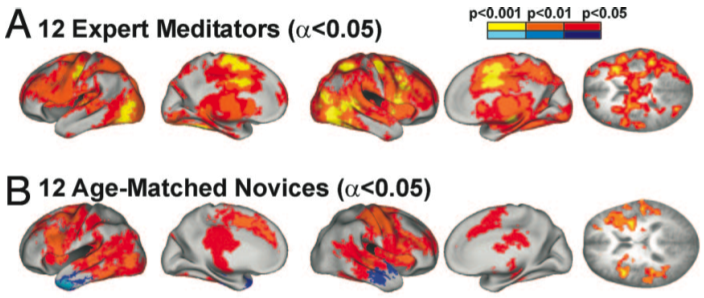
Fig 1. Expert meditators & non-meditators asked to focus on a dot for extended time. A) 12 expert meditators had greater overlap of increased activation of attention-related brain regions. B) 12 non-meditators had less overlap and activation. Orange hues equal higher correlation between individuals & activation. Blue hues equal little to no correlation between regions of activation.
We have all found ourselves struggling to concentrate on a thought through all the chatter and imagery in our minds. Often, it is a work related problem, other times we try to understand our relationships and throughout our lives we attempt to ponder existence itself. The predicament with focus and the clarity of thought presents itself as an enticing case for study at a neurophysiological level. Meditation as a set of techniques that requires the practitioner to regularly conduct thought exercises or hold steady attention on an internal/external stimuli, can help to identify & understand neural structures implicated in concentration. There are several recent research papers which provide some excellent insight into the contemporary study of how the brain behaves and is ultimately changed through meditation. In Neural correlates of attentional expertise in long-term meditation practitioners by J. A. Brefczynski-Lewis & A. Lutz, et al. the authors scanned the brains of 3 groups as they were asked to concentrate on a dot, using fMRI. The groups consisted of 16 non-meditators (NM), 11 non-meditators who were given an incentive of $50 if they were able to hold their attention (INM) and 14 expert Buddhist meditators (EM). Furthermore, the EM group was sub-divided into those with most hours of practice, with a mean of 44,000 hours (MHEM) and those meditators with less, mean of 19,000 hours (LHEM);each subgroup containing 4 meditators. Compared to NMs & INMs, EMs were found to have increased activation of attention-related brain regions of interest (ROI), while simultaneously having far less activation of regions unassociated with the task at hand, Fig 1. One of the most interesting results came from the comparison between expert meditator groups MHEMs and LHEMs; whereas LHEMs showed increased activation of ROIs & decreased activation of unassociated regions, MHEMs showed less activation of all brain regions while maintaining the most attention.
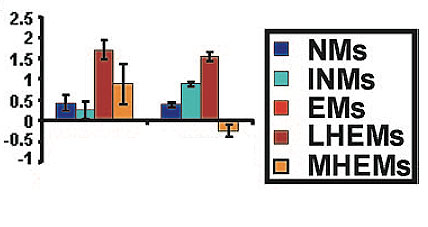
Fig 2. Bar graphs for amplitude of activation in the ‘‘early’’ part of the meditation block (the first 10 sec, excluding the first 2 sec because of hemodynamic delay) and the ‘‘late’’ part of the meditation block (120 sec to 200 sec)
What this all means- with a decent amount of practice one can cause greater activation of attention-related regions of the brain, while simultaneously reducing the level of “chatter” and the activation of unrelated brain regions. More interestingly, we see that even amongst expert meditators those with a mean 44,000 hours of meditative practice shows far less activation of all brain regions, including attention related ROIs, compared with meditators who have half as much practice(Fig 2); this demonstrates networks involved in meditation become optimized with increased use, that is it requires less activation, less resources to have the same concentration. Whatever goal one has, having greater focus with more ease will ensure greater success. This paper gives some live data of what is happening in the brain as one performs meditative tasks while showing us that those with extensive practice have a significantly different response, hinting at structural changes. What those changes could possibly be, is discussed in part two of this post.
Citations:
Brefczynski-Lewis JA, Lutz A, Schaefer HS, Levinson DB, & Davidson RJ (2007). Neural correlates of attentional expertise in long-term meditation practitioners. Proceedings of the National Academy of Sciences of the United States of America, 104 (27), 11483-8 PMID: 17596341
Filed under Meditation, Neuroimaging, Neurophysiology, Neuroscience
Practice makes perfect: Dendritic Pruning & LTP

Dendritic trees
It was about two years ago today, when I began to get a clearer picture of how the cells of the brain physically change as a result of our thoughts, experiences and actions. The mind is a result of a network of billions of individual brain cells, neurons, that exchange information with each other; much of the communication between neurons occurs through structures known as dendrites. These tree-like structures emerge from the main body of a neuron, the tips of each branch exchanging information with other neurons. As we develop habits & recurring thoughts, the neurons who communicate the most with each other begin to strengthen the dendritic branches that connect them. Simultaneously, the connections between neurons who don’t often speak with one another begins to atrophy, the dendrites start to prune themselves. These processes together encompass the much larger idea of neuroplasticity, the idea that our brain physically changes and adapts.

Dendritic Pruning
One of the best examples of this concept can be seen when drendritic trees of young mammals are compared with adults, we see extensive branching on the younger brains relative to the adults, supporting the idea that with experience unused connections are pruned off. One proposed mechanism by which the brain is capable of such adaptability is long term potentiation (LTP). The speed of neural communication is largely attributed to the electro-chemical nature of the transmission, allowing for large chunks of information to be rapidly shared across networks of millions of cells every second. LTP is a specific pattern of signaling between neurons where hundreds of bursts of electrical currents of a particular frequency are sent between two neurons; resulting in enhanced communication between the two neurons and strengthening of the dendrites involved, from that point onward. There’s a decent amount of speculation currently, looking to LTP as the mechanism by which our neurons prune their dendritic trees. What this means for you & me: the more we repeat an action or thought, the more the neurons involved in that process communicate with one other, resulting in a streamlining & strengthening of the connections between them; by the same token, routine will cause the number of neurons who can communicate with each other to degrade, possibly limiting what we can learn and understand as we age.

A: Neuron of Child | B: Neuron of Adult
More than ever before, we can observe how our physical minds change as a result of our actions and have a measurable candidate for the mechanism behind this adaptability. If the 20th century belonged to physics, the last several decades to genomics, it may not be a stretch to see the recent future of science be dominated with answering the questions of neuroplasticity and our minds as a physical structure.
Citations:
Yi Zuo, Guang Yang, Elaine Kwon & Wen-Biao Gan (2005). Long-term sensory deprivation prevents dendritic spine loss in primary somatosensory cortex Nature, 436 : 10.1038/nature0371
Kelly D. Hartle, Matthew S. Jeffers, Tammy L. Ivanc (2010). Changes in dendritic morphology and spine density in motor cortex of the adult rat after stroke during infancy. Synapse, 9999 (9999A) : 10.1002/syn.20767
Daniel McGowan (2006). Pruning processes Nature Reviews Neuroscience : 10.1038/nrn1997
Filed under Neurophysiology, Neuroscience
BOLD fMRI, a clear new view of the brain
 Hemoglobin carries the oxygen to our cells, which use it as energy. Our neurons use incredible amounts of energy when they fire electrical currents, which create our thoughts, actions, memories and senses. When a neuron fires, it takes up large amounts of oxygen from nearby hemoglobin molecules. As oxygen leaves it causes a change in the iron-rich structure of hemoglobin, which can be detected by Magnetic Resonance Imaging.
Blood-oxygen-level dependent fMRI allows us to see where in the brain oxygen is being consumed, correlating it with nearby neurons firing. This allows us now to literally map the brain based on activity. Which part of the brain is active during certain thoughts? Memories? Motor actions? BOLD fMRI can and has answered many of these questions. Contemporary studies with this technology has touched the edge of what we once thought possible, from algorithms that can scan our brains to guess what our eyes are seeing; to showing how meditation decreases the number of neurons firing in random areas of the mind. As we begin to settle into a comfortable pace of understanding and uncovering the functions of the brain in-terms of neurotransmitters and receptors, functional imaging of the mind provides a new horizon of understanding the mind as a complete neural network.
Citation:
Aguirre, G. (2002). Experimental Design and the Relative Sensitivity of BOLD and Perfusion fMRI NeuroImage, 15 (3), 488-500 DOI: 10.1006/nimg.2001.0990
Kay KN, Naselaris T, Prenger RJ, & Gallant JL (2008). Identifying natural images from human brain activity. Nature, 452 (7185), 352-5 PMID: 18322462
Filed under Neuroimaging, Neurophysiology, Neuroscience
Industry & Academia, part 1
The biotech, pharmaceutical and life sciences industry poses an interesting conundrum. How do we industrialize a profession of problem solving? From experience, I can say some have done it well, while others have treated the life sciences like a traditional industry. Much of the novel molecules which lead to profitable drugs often have their beginnings in academic research. Here a molecule or procedure showing promise is quickly gobbled up by an industrial giant, with very fair compensations of course. In academic research labs problem solving can bee seen to take a two-pronged approach. The first is collecting and presenting data which will ensure future and continued monetary funding. The second and more important aspect, is everyone in the lab understanding their individual projects from the bottom-up; to understand the basic concepts of nature which are guiding the protocols of an experiment. And it is at this where industry shows it’s largest short-coming. Departmentalizing work within a single project causes individuals to differ responsibility of the overall project success. This creates a lack of vigilance, people let flaws in experimental design slip by, those whose experience can best help troubleshoot aren’t even asked. The biotech industry isn’t young and fledgling anymore and allowing it to be run through the lens of a traditional business will do little to assure future success.
Filed under Uncategorized
A Breakdown of a Groundbreaking Article
Finding treatments for Parkinson’s disease helps more than just those afflicted with the illness. The mere act of studying the disorder and looking for a cure has increased mans understanding of the physiological structure of the brain and it’s relation to movement of the body.
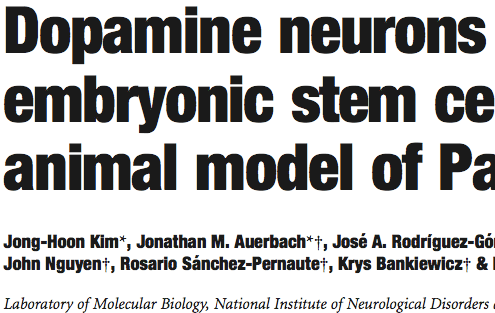 This article by Kim et al, was published in Nature, vol 418. These researchers are interested in deriving dopamine neurons from embryonic stem cells (ES cells); Parkinson’s disease is caused by the loss of neurons that produce dopamine.

Showing ES cells with Nurr1 has positive results for multiple markers of dopamine production
To quantitatively measure how much dopamine these ES cells could produce the researchers stained for tyrosine hydroxylase (TH), which catalyzes the conversion of L-tyrosine to dihydroxyphenylalanine (DOPA), the precursor for dopamine. Nuclear receptor related-1 (Nurr1) is a transcription factor that has a role in the differentiation of midbrain precursors into dopamine neurons.
In the study ES cell lines expressing Nurr1 are compared to native dopaminergic neurons and WT ES cells. Nurr1 ES cells outperform both comparative cell lines in TH stains, showing greater dopamine production.
Once the authors have demonstrated that their ES cell line with Nurr1 can produce dopamine just as well native dopamine producing neurons, they move on to graft the newly created cell lines to show that they don’t lose their capabilities within an animal model. At the very base, this study demonstrates the ability of embryonic stem cells to be turned into neurons capable of producing specific compounds, just as well native neurons.
Filed under Neurophysiology, Neuroscience, Uncategorized
Some thoughts on the mind
What do we currently know about the cellular structure of the brain? How does it affect our concept of reality? A quick & basic summary:

The cells of the brain, neurons, have a structure very different from the rest of the body.
At the center of the neuron is the soma, the core. From here branch-like structures called dendrites emerge. The axon, is a single stem which can extend from the soma to very distant spaces, ranging from inches to several feet.
Every thought, feeling, perception, or memory causes an electrical potential to be generated at the soma, passed down the axon and then transferred to other neur ons through dendrites. There are millions of connections between neurons, turning the whole brain into one large network.
This is the stage on which our reality unfolds, everything we learn, everything we feel, all movements and all thoughts occurs through the medium of our neural network.
Filed under Neurophysiology, Neuroscience, Uncategorized




 Petri Dish Talk